{{ 'fb_in_app_browser_popup.desc' | translate }} {{ 'fb_in_app_browser_popup.copy_link' | translate }}
{{ 'in_app_browser_popup.desc' | translate }}
Understanding the Loudness of Sound and How It Affects Hearing
The amount of sound a person subjectively perceives as "loudness" is also known as "volume." The unit of measurement for noise is called "sound pressure" in dB.
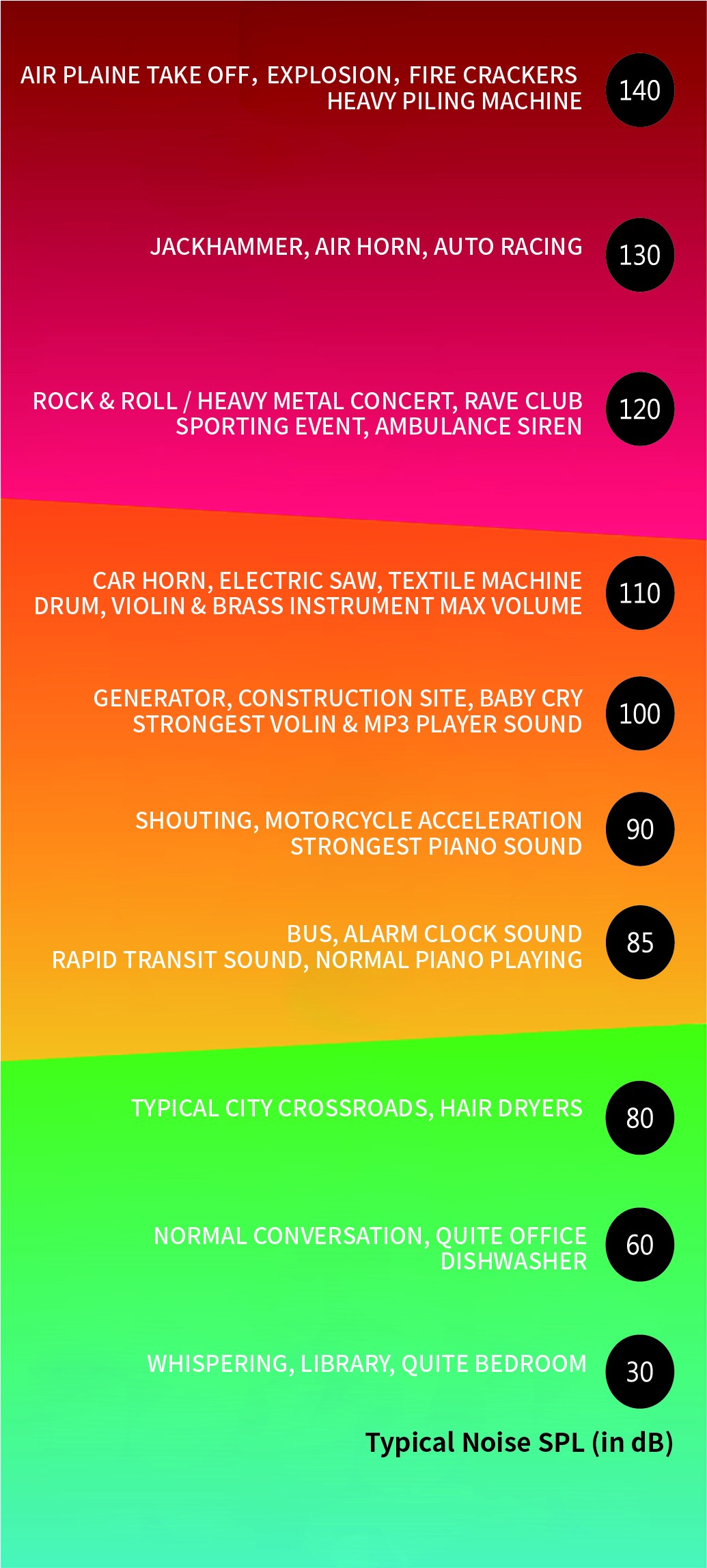
According to the International Organization for Standardization (ISO) standards, the left diagram shows the sound pressure values under various conditions. The loudness at which a person can begin to hear a sound is defined as "0" decibels, with a maximum of 140 decibels being the general rule. Hearing a sound this loud will cause most people to become temporarily deaf. Some may even suffer a stroke or cardiac arrest.
Even normal loud noises can cause tinnitus, hearing loss, irregular heartbeat, increased blood pressure, loss of appetite, etc. Physiologically, it can also cause irritability, reduced work efficiency, distraction, and sleep disturbance.
Prolonged exposure to loud sounds will lead to "auditory fatigue," which is the "temporary hearing loss" after exposure to too much sound. This temporary shift in auditory thresholds is called a "temporary threshold shift (TTS)." If further exposure to excessive sounds is continued without allowing the ear enough time to recover. In this case, it becomes a "Permanent Threshold Shift (PTS)," and a permanent threshold shift is called hard of hearing. People with hearing loss can lose the ability to recognize certain sounds. Most commonly, other people's speech sounds, resulting in communication problems and loss of life and work functions.
The national standard stipulates that the workplace's noise level shall not exceed 85 decibels for eight hours of work. This standard can be relaxed to 90 decibels for existing enterprises that cannot temporarily meet this standard. It is also stipulated that the noise standard can be relaxed for workers exposed to noise for less than eight hours, but no matter how short the exposure time is, the maximum noise intensity shall not exceed 115 dB.
The basic rule is that the exposure time shall be halved for every 3 dB increase in loudness.
According to this rule, the safe listening time is:
at 85 dB 8 hours
at 88 dB, 2 hours,
at 91 dB, 1 hour,
at 94 dB, half an hour,
at 97 dB, 15 minutes,
at 100 dB, 7.5 minutes,
at 103 dB, 3 minutes and 45 seconds,
at 106 dB, 112.5 seconds,
at 109 dB, 56.25 seconds,
at 112 dB 28.125 seconds,
at 115 dB 14 seconds.
You can refer to the diagram on the left to see related activities at different loudness levels。
We recommend that you wear hearing protection before entering any environment where there is an excessive amount of sound. Unfortunately, you cannot restore any lost hearing ability.
Which Is More Likely to Cause "Hearing Loss," Music, or Noise?
The correct answer is that if the noise level is the same as the music, then the chance of hearing damage is the same. Of course, music sounds very comfortable, while noise sounds harsh, so noise also puts more physical stress on you.
Noise is the sound we don't like. The sound of a new child playing the violin can be painful for you. However, when the teacher plays the same violin, the music will be pleasing to you. We know that a violin is supposed to produce a constant range of frequencies, so the frequency is irrelevant to whether it is noise or not.
The ancient Greek mathematician and philosopher Pythagoras found that the ratio of two frequencies was music or noise. He found that if the ratio could be reduced to a simple ratio of 3:7, for example, the sound was pleasant music; if it was an irreducibly complex ratio of 201:388, for example, the sound was harsh and unpleasant noise.

Hazards of Hearing Damage in The Industrial Environment
Working in an industrial setting exposes you to many different types of hazards. One of these is hearing loss due to prolonged exposure to high decibel noise. Unfortunately, many people with hearing loss are under the mistaken impression that noise and work are two sides of the same coin, so you have to live with it.
It couldn't be more wrong; hearing impairment results from prolonged exposure to too much sound. If you're willing to follow some life-changing habits, you can safely maintain your hearing. This way, you can enjoy things like listening to music, having trouble-free conversations with family and friends, and listening to your children or grandchildren laugh.
Industrial noise is mainly constant mechanical noise. Machinery and equipment of the same type produce the same amount of noise, so the number of machines running determines the overall noise level. Even if it isn't deafening, the cumulative dose of constant noise can be powerfully damaging to hearing because of prolonged exposure over an uninterrupted period of time.
The point is because there is no way to actively reduce the noise level or reduce the normal eight-hour working day, you must be stuck in this noisy environment day after day for years and years. It would help if you had a pair of earplugs that are easy to use, effective in reducing noise to a safe level, and comfortable and effective in protecting your hearing.
The Most Common "Noise-Reduction Earplugs" Types
Foam Material: Straight Earplugs, Bullet-Shaped earplugs, Multi-Ringed Foam Earplugs
The foam material has a good noise reduction rating. If foam earplugs can fit tightly in the wearer's ear canal, they can provide excellent noise reduction. However, single-sized products cannot create a good seal with different-sized and shaped ear canals. Thus, the manufacturers of foam earplugs have developed a formula (minus 7 divided by 2) to calculate the actual noise reduction rating achieved with foam earplugs. Another problem with foam earplugs is that they rely on the foam's expansion force to fill the ear canal. The ear canal deforms as people move about or talk, which causes the earplugs to loosen then slowly slip out, resulting in sound leakage.
Silicone Material Multi-Ring Earplugs
Multi-ring silicone earplugs have double or triple rings. Typically they a small aperture audio restrictor to reduce the sound volume inside the ear canals. It is akin to looking at the sun through a pinhole. The soft round rings of the multi-ring silicone earplugs deform easily. The earplugs fit the ear canal without the forceful ejection feeling of the foam earplugs. The smooth surface does not irritate the delicate ear canal skin as foam does, so it feels good to wear. The audio restrictor port also provides a degree of canal ventilation, which improves from the foam earplugs. However, fixed-sized and shaped silicone multi-ring earplugs do not fit people with different canal sizes and shapes.
Foam-Filled Headband Earmuffs
Headband earmuffs must be fully cover the ears and fit snugly to the head to create an effective noise isolation seal. The tight fit requires considerable pressure and is often painful for the wearer. The earmuffs are not airtight, resulting in a severely uncomfortable feeling of heat. When used as intended, earmuffs provide excellent sound isolation. But the downside is that they are bulky and not very comfortable to wear.
The earplugs can come loose and require frequent manual adjustments. The earmuffs are bulky and stuffy. Causing many industrial workers not to wear these protective devices, creating their hearing deteriorations as they work.
ACS PRO‘s Hearing Protection Concept
ACS has been promoting hearing protection for over 26 years and has worked with world-renowned DJs, singers, musicians, and bands from the UK, Europe, America, and Asia and supply the UK police, military and industry with hearing protection earplugs. Here's how we think about industrial noise and how we approach our products.
Whether it's noise or music, as long as the volume is the same, the chance of hearing damage is the same. However, the human ear has different sensitivities to different frequencies of sound, so different frequencies with the same loudness will not cause the same hearing damage. Because of this phenomenon, you can't use the average loudness of the entire frequency range when you deal with noise. You must also evaluate the measurements from different frequency bands to find the best countermeasure.
There are many noisy machines in a factory, just as there are many speakers at a concert. The noise from industrial machines is like the music from musical instruments, with some machines producing low-frequency noise and others making high-frequency noise. The same volume of music and noise has an equal chance of damaging people's hearing. Therefore, we will use ACS PRO custom earplugs similar to those used by the world's top musicians during live performances to meet workers' hearing protection needs in industrial environments.
The work "custom earplugs" use the PRO 20, PRO 26, PRO 27, and PRO 31 filter models, of which the PRO 20 and PRO 26 are also used in music earplugs. The PRO 20 and PRO 26 are also used for musical earbuds because the frequency curves of these PRO filters are just right for some of the noise reduction needs of music and industrial environments. Remember when the same frequency in different ratios can determine whether it's noise or music?
Do Good Earplugs Need TocKeep You From Hearing Any Sound?
This is one of the most common questions we get asked.
First of all, unless you were born deaf or have a hearing loss defined as legal deafness, you will hear sounds no matter what. The starting point of human hearing is 0 dB, and 140 dB is the maximum sound level generally considered damaging to the human ear. Decibels are logarithmic units of 10, and every 3 dB difference halves or doubles the sound. There is a 100 trillionfold difference in volume from 0 dB to 140 dB. Human hearing acuity can distinguish such a massive difference in sound. Therefore, unless you are born deaf or legally deaf, you will hear some sound.
Secondly, although noise can cause a lot of physical and psychological discomfort, we still need to hear something, even in extremely noisy environments. Suppose a pair of "super earplugs," which can isolate 99% of the noise. Wearing them, the factory is as quiet as a library. However, when a production machine develops a problem, the machine emits a different sound than running normally. You continue to work because you can't hear anything. Suddenly, the machine stops completely. At this point, you realize that there is something wrong with the machine. Unfortunately, it is now not a simple glitch but complex and severe damage.
When you work, you always need to communicate with peers. You need to hear instructions from your supervisor or machine's annunciations or alarms. So not being able to hear anything is not necessarily the best solution. Besides, if a normal person is suddenly unable to hear anything, it can cause great physical and mental discomfort.
ACS PRO Filters Allow You To Hear The Surrounding Sound At A Safe Volume
In the past, the way to eliminate noise was to block sound from entering your ears, using fingers, paper, cloth, foam earplugs, or foam-filled earmuffs, but the basic concept was all about blocking.
Most of the time, the sound we hear comes from a mixture of sources. However, foam cannot finely control the sound frequencies that pass through it, and if it is worn properly, most of the sound is blocked, and only a small portion can pass through. The earplugs must be removed to communicate with others, and the complete lack of protection causes hearing loss.
We need to hear some of the sounds at work, and barrier products really don't meet this need. The line manager is a perfect example. There are so many machines on the production line, responsible for so many different steps that each machine's output has to be just right every day. However, a factory cannot have all machines running perfectly every day.
The supervisor has to go to the machine that has a problem and talk to the employees to determine the problem. Therefore, neither he nor the employees can wear "blocking" earplugs, which must be removed to communicate. ACS PRO filters will reduce harmful elements and allow you to hear a clearer and safer sound.
The illustration shows the difference in effect between (blocking and filtering).
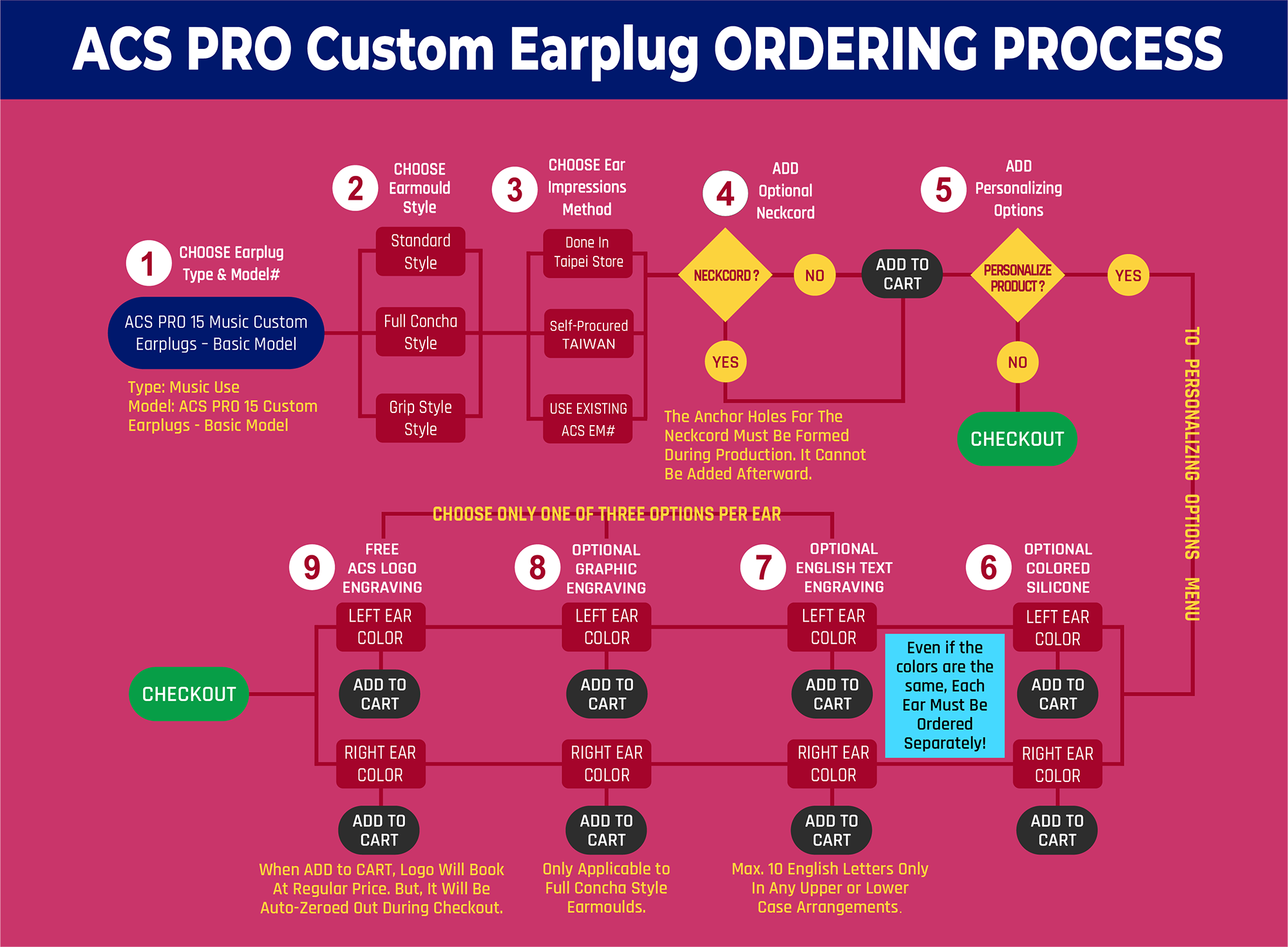
The Order Process for Custom Earplugs and links to the product page for each model