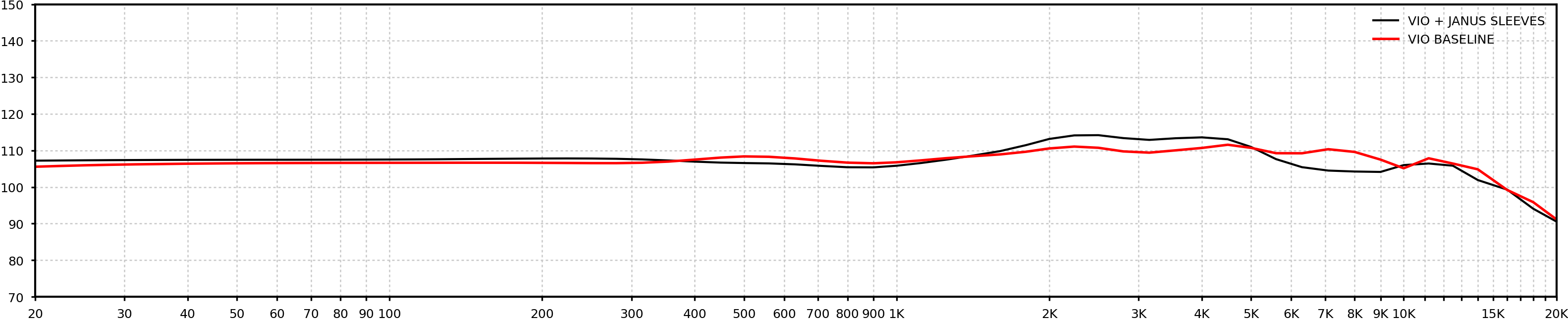
BASELINE vs JANUS Sleeves Frequency Band Differences
Low Frequency (20–250Hz)
BASELINE
Delivers a naturally balanced low-frequency structure with deep extension and controlled response, maintaining full dynamic space and a sense of air movement.
JANUS SLEEVES
The extended custom sleeve modifies the terminal acoustic load, slightly increasing low-frequency density and focus. This provides more stable rhythmic support and concentrated energy in live performance settings.
Midrange (250Hz–2kHz)
BASELINE
Maintains a natural midrange proportion with accurate imaging, ideal for studio monitoring and detailed evaluation.
JANUS SLEEVES
Vocals and key instruments are subtly brought forward, improving intelligibility and projection in high SPL and reverberant live environments.
Upper Midrange (2–6kHz)
BASELINE
Preserves a clear, open soundstage with refined detail, remaining smooth and non-fatiguing.
JANUS SLEEVES
Changes in ear canal length slightly shift resonance behavior, redistributing energy within this critical range to enhance articulation and positional accuracy on stage.
High Frequency (7–20kHz)
BASELINE
Extends naturally and smoothly, delivering a wide soundstage and airy presentation while maintaining both accuracy and musicality.
JANUS SLEEVES
The high-frequency extension becomes slightly more focused and controlled, reducing harshness at high SPL while preserving essential detail and transparency.The True Meaning of Dual Mode Design
BASELINE and JANUS SLEEVES are not two different sound signatures, but two applications of the same acoustic core under different terminal acoustic conditions.
The subtle differences shown in the frequency response graph are not tuning variations, but the result of changes in acoustic loading caused by ear canal extension length. Adjustments in terminal load, resonance distribution, and high-frequency coupling behavior directly influence projection, imaging stability, and intelligibility in real-world performance environments.
BASELINE preserves the original balanced response and full dynamic headroom, serving as the reference mode for studio monitoring and critical listening.
JANUS SLEEVES, through its extended custom sleeve structure, optimizes the acoustic load for high-SPL stage environments, concentrating vocal presence and key frequency regions for improved clarity and focus.
The purpose of Dual Mode Design is not to create two different sounds, but to ensure that the same acoustic system performs optimally across different professional scenarios.
One acoustic core. Two acoustic applications.
Engineered for performance.